
Pittsburgh Opera’s ‘Orpheus & Eurydice’ is Solemn Joy
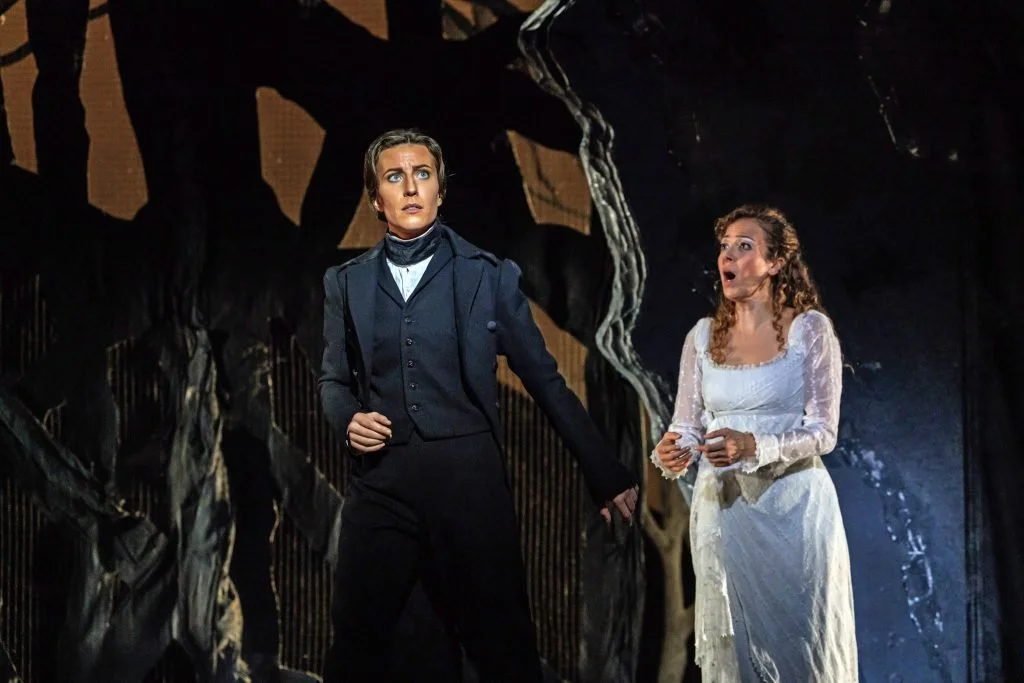
Orpheus (Stephanie Doche) leads his bride Eurydice (Lauren Snouffer) out of the mouth of Hades.
Entertainment Central Pittsburgh by Prentiss Orr - In modern theatrical lingo, Orpheus and Eurydice would be called a “three-hander,” meaning as a production on the live stage, this drama has just three characters: Orpheus, a musician and mere mortal with the voice of a god; his bride, Eurydice, a woman of inordinate beauty; and, Amour, a god who has the power, in the name of love, to return the dead to life. The story is pretty simple, too. A new bride, Eurydice, dies suddenly and her husband, Orpheus, mourns deeply. His grief is so deep, in fact, it attracts the sympathy of a god, Amour, who allows him to retrieve his bride from the world of the dead. The husband is forewarned by Amour that he may not look upon his wife’s beautiful face until the two are back in the land of the living. But, mortals being mortal, the story becomes a tragedy. The husband and the wife trip over their own human frailties.
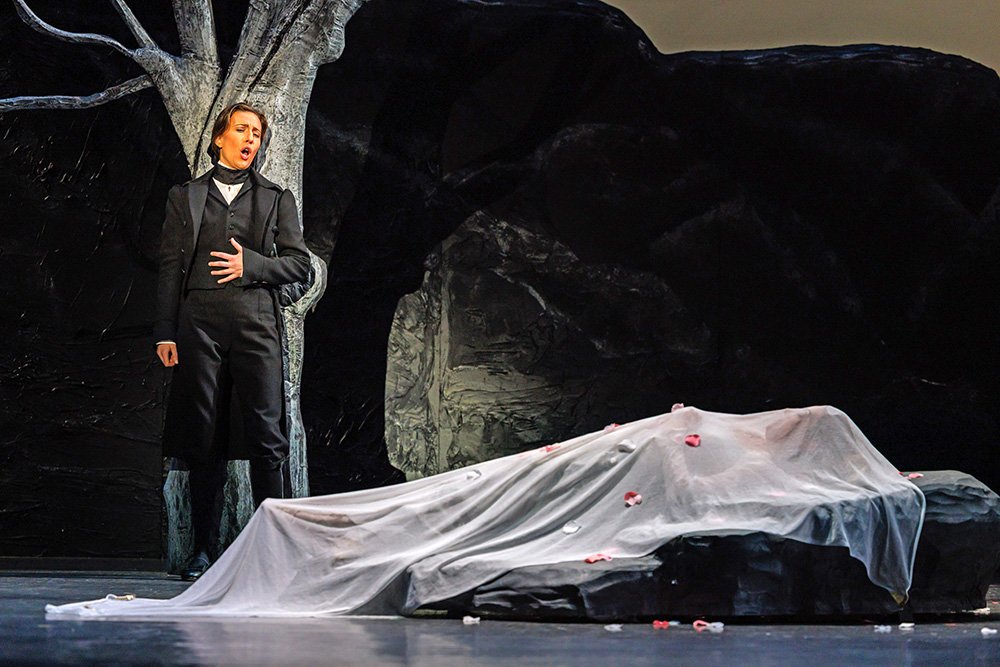
Orpheus mourns the death of Eurydice shrouded in funereal cloth.
Since 1762, when composer Christoph Willibald Gluck first adapted the mythological adventure of Orpheus and Eurydice into the opera Orfeo ed Euridice, the operatic stage has seen dozens of dramatic versions. (And many preceded Gluck’s, actually). In fact this classic and very popular version is sung in French. Yet each adaptation offers different twists on how Eurydice dies, when, and for what divine reason or purpose, and each proposes varying hierarchies of the god or gods who take sympathy on the plight of Orpheus. Invariably, however, there’s one rule that Orpheus breaks while returning Eurydice to life: he is not to look upon his bride’s face. Why? It’s not said. Furthermore, in many versions including this one, Orpheus is not allowed to explain the rule while rescuing her. As such, Eurydice, upon her heroic rescue, begins questioning her husband’s apparent indifference. And Orpheus would so rather defend his integrity, he gives in to her sorrow, looks upon her beauty, and she dies, again.
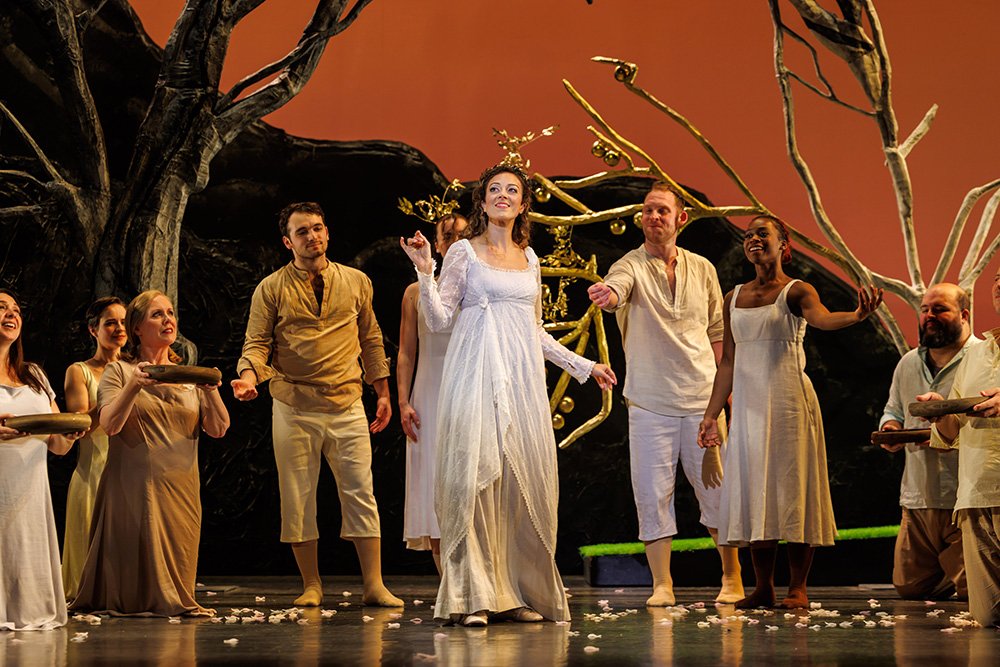
The bride in white, Eurydice rejoices in her world of newfound love and abundance.
What the hell? The story of Lot’s wife in the Bible has her defying the wishes of God for doing something akin to Orpheus; she looks back at the destruction of Sodom (mind you, at the wrathful hands of God) and is turned into a pillar of salt. Medusa, the Greek demigod whose hair writhes with snakes, has a face that will kill anyone who looks (directly) at it. The Inuit people fear Taqriaqsuit (“the shadow people”) whose faces, when seen by a villager, will turn them invisible. And then there’s mirror-evading Dracula and, by contrast, Narcissus who dies from hunger because he can’t stop looking at himself. These are the stories, lore and legends that all have roots in the human psyche. Of course, I have no claim to scholarship, but these are also common nightmares. The legitimacy of myth or legend is that they replicate all manner of dreams. We mortals cannot seem to run fast enough when being chased by something grossly dangerous, we can never locate the one person or gift we are on a seemingly endless mission to find, and, because we have not bothered to follow a class schedule, we are now doomed to fail some imminent exam. Fears, desires and frustrations haunt our lives. And that’s the theme of Orpheus and Eurydice.
As such, we are welcomed into the theater to relive a story of which we are familiar. For this reason, the characters, the costumes, the sets—perhaps, even the dialogue and the music—must share some common ground in place, manner and time that meets an audience’s collective expectation. Indeed, we are introduced in Act One with a funeral procession. Orpheus grieves the death of his wife whose body is carried by villagers dressed in contemporary cuts of black dresses, black jackets, and creased slacks. Eurydice is dressed in a white, full-length gown. Orpheus wears a black suit, its style akin to a Dickensian waistcoat and jacket with tails. He also sports a wide black cravat over a white shirt. They all proceed across a set with a large, windswept tree of barren branches, ancient, crumbling pillars, and the spaciousness of a public cemetery. As Orpheus grieves, Eurydice is laid on the ground and draped with a large white cloth which is then strewn with rose petals. Four unidentified mourners then proceed to ritually wipe their own arms and faces with some sort of balm or dark oil. Other mourners lay down piles of small flat rocks, while yet more lay down lit candles. The scene is set, decorated, and activated by familiar, funereal references and gestures such as these. But then the “love god” Amour arrives. I won’t say how, I won’t describe what she wears, nor the character she affects, but suddenly, this beautiful, sorrowful, solemn first act has been turned into a joke. Or is it a creative jest? You be the judge. What the hell? The story of Lot’s wife in the Bible has her defying the wishes of God for doing something akin to Orpheus; she looks back at the destruction of Sodom (mind you, at the wrathful hands of God) and is turned into a pillar of salt. Medusa, the Greek demigod whose hair writhes with snakes, has a face that will kill anyone who looks (directly) at it. The Inuit people fear Taqriaqsuit (“the shadow people”) whose faces, when seen by a villager, will turn them invisible. And then there’s mirror-evading Dracula and, by contrast, Narcissus who dies from hunger because he can’t stop looking at himself. These are the stories, lore and legends that all have roots in the human psyche. Of course, I have no claim to scholarship, but these are also common nightmares. The legitimacy of myth or legend is that they replicate all manner of dreams. We mortals cannot seem to run fast enough when being chased by something grossly dangerous, we can never locate the one person or gift we are on a seemingly endless mission to find, and, because we have not bothered to follow a class schedule, we are now doomed to fail some imminent exam. Fears, desires and frustrations haunt our lives. And that’s the theme of Orpheus and Eurydice.
As such, we are welcomed into the theater to relive a story of which we are familiar. For this reason, the characters, the costumes, the sets—perhaps, even the dialogue and the music—must share some common ground in place, manner and time that meets an audience’s collective expectation. Indeed, we are introduced in Act One with a funeral procession. Orpheus grieves the death of his wife whose body is carried by villagers dressed in contemporary cuts of black dresses, black jackets, and creased slacks. Eurydice is dressed in a white, full-length gown. Orpheus wears a black suit, its style akin to a Dickensian waistcoat and jacket with tails. He also sports a wide black cravat over a white shirt. They all proceed across a set with a large, windswept tree of barren branches, ancient, crumbling pillars, and the spaciousness of a public cemetery. As Orpheus grieves, Eurydice is laid on the ground and draped with a large white cloth which is then strewn with rose petals. Four unidentified mourners then proceed to ritually wipe their own arms and faces with some sort of balm or dark oil. Other mourners lay down piles of small flat rocks, while yet more lay down lit candles. The scene is set, decorated, and activated by familiar, funereal references and gestures such as these. But then the “love god” Amour arrives. I won’t say how, I won’t describe what she wears, nor the character she affects, but suddenly, this beautiful, sorrowful, solemn first act has been turned into a joke. Or is it a creative jest? You be the judge.
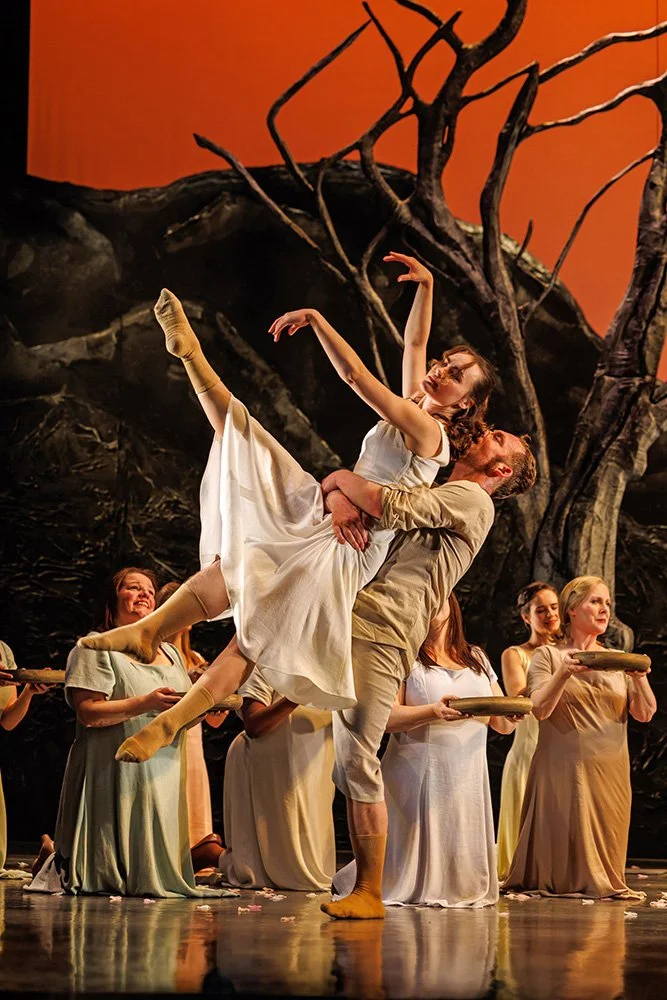
Attack Theatre dancers and a full-voice chorus lend stunning support to a simple story.
Traditionally and typically performed by women (or boys), Orpheus, the husband with the voice of a god, was sometimes sung by sopranos (even castratis) to prove “his” exceptional talent. Stephanie Doche is Orpheus. Her contralto carries extremely well on a stage that requires her masterful performance in every scene. She meets the challenge with extraordinary attention to grief, passion and shame. Doche is herself extraordinary in a very demanding role. Lauren Snouffer, in her Pittsburgh Opera debut, sings Eurydice. Her soprano is bright and as beautiful as her own face truly is. And her stage presence is only matched by that of Doche who, at the opening of the third act, must share in the opera’s great duet, “Viens, suis un époux qui t’adore” or “Come, follow a husband who adores you.”
As Amour, despite her jarring introduction,Léa Nayak turns her pivotal role into an expression of joy, charm, and dramatic control. A resident artist with the Pittsburgh Opera, Nayak is a strong soprano who shines in many more ways than one. Also exceptional are the dancers of Attack Theatre who play the “furies” as were the Pittsburgh Opera choristers who played the “ghosts and dreadful shades.” The writhing choreography terrorizes Orpheus’ descent into the underworld. If one were to question director José Maria Condemi’s choice of characterization for Amour, he deserves much credit for this very successful element of incorporating dance and movement in a world considered to be motionless. Attack Theatre choreographers Peter Kope and Michele de la Reza have guided dancers Savionne Chambers, Mia Giovanna Kuzma, Jax R.F. McAtee, and Will VanSlander in a slithering sea of contortion that’s truly sensational. Equally successful is the ever-present chorus of twelve who parade in the opening funeral, the nether world of Hades, and the final act, greeting the audience back to the land of the living and the loving.
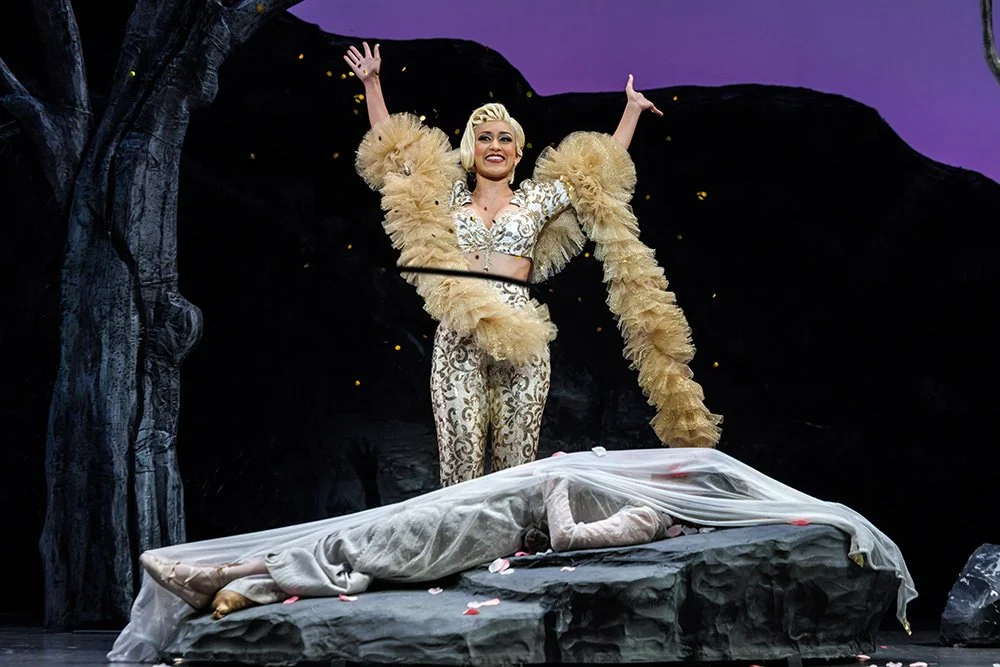
Amour (Léa Nayak,) the god of love, is a many splendored thing, if not a character beyond the pale.
Pittsburgh Opera’s Orpheus and Eurydice is on stage(opens in new tab) at the Byham Theater through this Sunday, which may be important to note for patrons who often attend the Opera’s seemingly larger productions at the Benedum. But the Byham works beautifully for this production with a smaller cast and a set that fills the smaller stage. Kudos to scenic designer Steven Kemp and lighting designer Mary Ellen Stebbins for creating a world of the dead that is both horrific and holistic; the theme of barren tree limbs has exposed their roots descending into Hades and it’s all lit harshly and brilliantly as underworld events unfold.
Further credit is due costume designer Robert Perdziola and wig and make-up designer James Geier (audiences will surely want to “compare and contrast” their fine work on Orpheus’ costume with that of Amour’s extravagance). And, finally, there can be no question that the Pittsburgh Opera is blessed with an incredible orchestra led by conductor Antony Walker. The contribution of a live orchestra to a story of grief and resurrection makes every minute of this production meaningful and memorable.
Photos by David Bachman Photography.